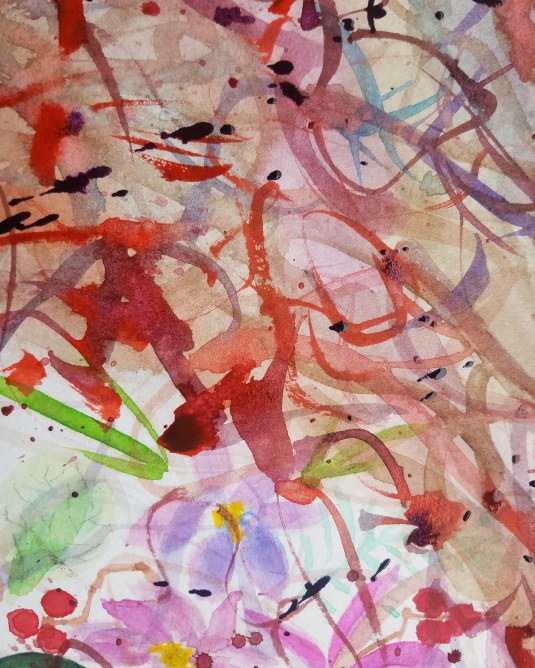
Abstract art can be tough for me. I tend to use my head over my heart, so the images are not easy to understand or rationalize. Yet this abstract watercolor by my dear friend Kira hit home at first glance. My heart grieves for the world we have left behind as this virus has encircled the globe. My head cannot begin to wrap around what we are going through or where we will end up. Kira calls her work ‘Viral Encroachment’ – a fit title to explain how this tiny organism has taken hold of our daily lives. Something we cannot see has changed everything we can see. An unseen force has taken over, very slowly then all at once. I pondered the sort of things that work that way, piling up over time until the burden is intolerable. Each incident is not that big of a deal until you get to the last straw that tips you over the edge.
We pray about those little indiscretions every Sunday as part of the service. In the Lord’s Prayer, we ask God to ‘forgive us our trespasses as we forgive those who trespass against us’. Other translations substitute debt or sin for trespass, but what are we really talking about? It was time to go back to the original text in Greek. It was time to ask our parish priest, Pete. In his words:
The Greek word is paraptoma: para = around or alongside; ptoma = slip, trip, or fall. Literally, it means to fall alongside of or more simply, to fall away from. Idiomatically, though, it gets tricky, especially for translators. It’s a verb, action, trying hard to be a noun, thing. Thus we get something like “slips” or “lapses.” For once, the King James translators weren’t that far off the mark when they came up with “debts,” in the sense of things worthy of grudges. Sadly, using the word “sin” really defeats the purpose, as it doesn’t look like what we think Jesus was trying to convey, but there it is.
The really interesting thing, at least to me, is that trespassing implies a moving forward into forbidden territory, whereas paraptoma suggests an accidental falling away from the good. It’s almost as if the translation is opposite Jesus’ intent: a paraptoma is, for all intents and purposes, an accident; a trespass is an intended wrongful act. – Reverend Doctor Peter R. Gustin
This virus cannot move on its own – people carry it from place to place, from person to person. You are contagious once you contract the virus, but symptoms may take a week or more to appear. Surfaces can hold the virus and be picked up by another person touching an affected area. All of this sounds a lot more like a series of little accidents, careless indiscretions, thoughtless actions. Each incident doesn’t seem like much but over time we end up with more than we could begin to imagine possible. It is easy to succumb to fear, to look for someone to blame. Yet are we really angry at any single individual, or are we simply furious at the whole situation?
Make time today to hold open space for grace. Consider each little act more like an accident. Forgive as you wish to be forgiven. Take precautions to safeguard yourself and others out of love instead of fear. Look for new ways to socially connect in the current climate of social distancing. Take time to check in with one another, especially folks we would normally see on a regular basis. Most of all, let each of us lean on God’s strength rather than our own. As Brother Lawrence would say ‘My only chance of success is with you, Lord, for alone I shall surely fail’.
Text by Connie Chintall ©2020, All Rights Reserved
Greek origin of ‘trepasses’, reflection by the Reverend Doctor Peter R. Gustin
Watercolor entitled ‘Viral Encroachment’ by Kira Skala©2020, used with her permission, All Rights Reserved.
 There are days when I wonder who I am. How do I define myself? How do I hold on to who I am in the face of daily personal challenges and bewildering news stories? I keep going back to this intriguing image of an old, rusted Ford Fairlane. The sedan is long past its prime and even the vine attached to it seems to lack life. I joined the military almost forty years ago after a series of poor decisions. I walked away from a full scholarship at the University of Virginia, or perhaps it is better to say I ran away with a truck driver. I chose my heart over my head, for a relationship I thought would last the rest of my life. Instead, I found myself back home with my parents, without that relationship, without my education, without a job. I took a few jobs that paid well and was promoted quickly, only to find I had topped out since I lacked a college education. So I enlisted in the Air Force and headed off to basic training. Fifty women were housed in an open bay barracks. Each of us had a bed, a chair, a narrow closet and two dresser drawers. A corner of the bottom drawer was allotted for ‘personal effects’. Everything else I had brought with me was stored away under lock and key. I kept a box of stationery with family pictures tucked inside. I kept my prayer book. And I kept a favorite cotton shirt I had sewn and embroidered. Over the next six weeks, every waking hour was spent in training. We learned how to dress, how to march, how to fold our clothes. On Sunday morning we could go to church or stay in the barracks and clean. Most gals went to the generic Protestant service. I chose to walk across the post to the Episcopal service, risky business since new recruits were subject to spot inspections and dreaded demerits. By the time I sunk into the pew, soaked with sweat, I wondered what I had been thinking. The first half of that service was a blur. Then they played the communion hymn, ‘Humbly I Adore Thee’. This hymn was the summer favorite at St. Mary’s in Burlington, NJ. My bones know the words to this hymn and I felt an immediate sense of God’s love. I walked back to the barracks humming it. Over the next few days I found myself again, the me I traded away when leaving college. As I became more myself, I found it easier to connect with the fifty women in my unit. We scrubbed the floors singing that hymn, then a country western tune, then a Motown hit. We stopped being fifty separate women and became a single unit. We shared who we were and became more than the sum of our parts. As individuals we were like this rusted out car. Even the vines they tried to lay over us failed to offer connection. It was singing as we worked that brought us together. There are two pieces to the cross. The upright connects us to God. The horizontal connects us to one another. The essence of our humanity is the divine spark in each of us. Yet without connection we simply sputter out and fade away. Make time today to connect with the Holy of Holies. Lay the weariness of the world at God’s feet, then crawl into God’s lap and rest in unending love. Share what feeds your soul with a friend over a cup of coffee or simple lunch. Let go of canned expectations and sensational news. Look beyond the surface and listen to the hearts of those you meet, even when what you hear is uncomfortable. God does not expect us to all be the same yet God loves us all the same. May God grant us the courage to open our hearts and be vulnerable to one another so that we may we love one other just as God loves us. Text by Connie Chintall©2016, Photo entitled ’55 & Vine’ by Rick Martin©2016, All Rights Reserved. To see more of Rick’s work, go to





 Seek the Sacred Amidst the Ordinary