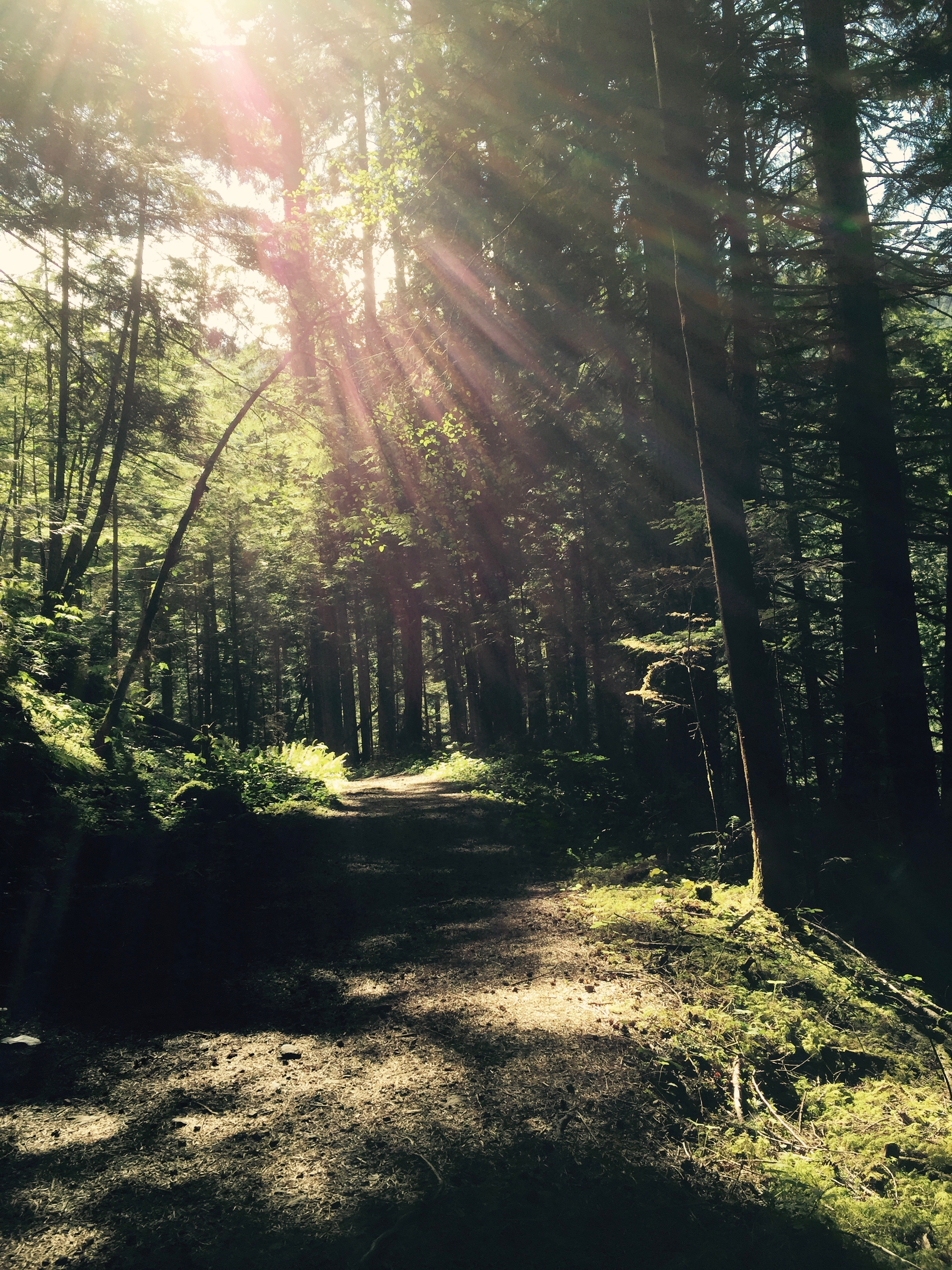
Walking in the woods soothes my soul. I feel like I am praying with the trees, that together we are grateful for the bounty of creation and the gift of light. Sunlight filtering through the trees never ceases to astonish me. As I follow the trail, the shade of the forest is comforting, almost like being wrapped in a cozy blanket. Then the sunlight bursts through and I begin to see how dark the path has become. I did not expect the light because I had grown used to the shade. Or had I? After all, the trees can only exist because of the light. Perhaps my comfort with the forest is a deeper understanding of a quality we all share with the trees. We are both children of the light.
Yet I see more than sunlight bursting through the trees in this photo. The path ahead is not clear. It bends away from us beyond the light, turning in a new direction. How long do we spend in awe of that burst of light? How quickly do we jump ahead to the bend in the road? How easily do we lose the present moment to speculation about the future? Or perhaps lose the present to the past, limiting our understanding of the now only to what has come before.
If you find yourself lost in the past or the future, you are in good company. C.S. Lewis wrote about this fundamental human condition in The Screwtape Letters, a training manual for a junior devil on how to tempt us poor souls.
The humans live in time but our Enemy [God] destines them to eternity. He therefore, I believe, wants them to attend chiefly to two things, to eternity itself, and to that point of time which they call the Present. For the Present is the point at which time touches eternity…..He would therefore have them continually concerned either with eternity (which means being concerned with Him) or with the Present–either meditating of their eternal union with, or separation from, Himself, or else obeying the present voice of conscience, bearing the present cross, receiving the present grace, giving thanks for the present pleasure.
Our business is to get them away from the eternal, and from the Present. With this view, we sometimes tempt a human (say a widow or a scholar) to live in the Past….[However] it is far better to make them live in the Future.…Future is, of all things, the thing least like eternity.
[We must] fix men’s affections on the Future, on the very core of temporality. Hence nearly all vices are rooted in the future. Gratitude looks to the past and love to the present; fear, avarice, lust, and ambition look ahead….He[God] does not want men to give the Future their hearts, to place their treasure in it. We do.
(The Screwtape Letters , pp. 75-77)
To speculate means to form theories about what will happen next, theories frequently without basis in fact. We think first of investments with high risk and high payoff, of speculation in terms of money rather than time or faith. Yet speculation was once a synonym for meditation or reflection.
So where do we go wrong with speculation? We lose the present when we get ahead of ourselves. We miss crucial information that can inform our view of things to come. We begin to overthink the current situation, to second guess ourselves, to allow doubt to seep in and steal our present joy. The Buddhists call this temptation ‘speculative doubt’. Saint Augustine called it ‘anxious imaginings’. Perhaps the modern epidemic of anxiety has its roots in this corrosive form of pondering the future.
Make time today to simply dwell in the present. Let the beauty that surrounds you soothe your soul and seep into your heart. Learn to be comfortable being uncomfortable, seeing discomfort as necessary for growth. Let your imagination and speculation ponder a future of possibilities, rather than a projection of past disappointments. Most of all, accept the gift of the present moment and allow it to become your window into eternity.
Text by Connie Chintall ©2021, All Rights Reserved
Photo of Lower Big Quilene Trail in Olympic National Park, entitled ‘Light and Shadow’ by Cheryl Lindsey©2018, used with her permission, All Rights Reserved.
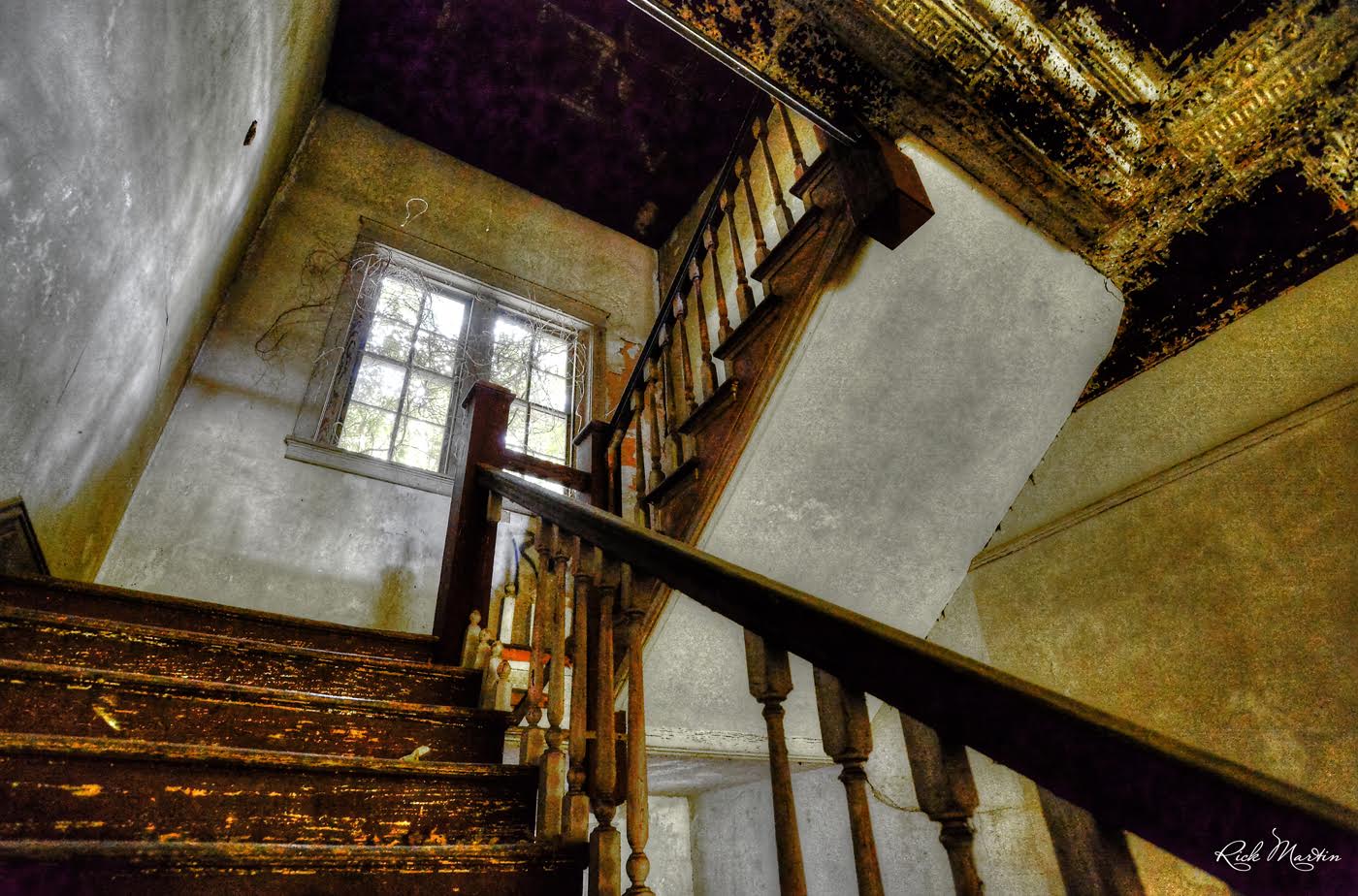 Easter has come and gone and we are working our way through the Gospels concerning Christ’s appearances after the resurrection. I have always had trouble with the scripture in John 20. We find the disciples huddled together in an upper room with the door bolted out of fear. I wonder how far out of the way they went to find a place to hide. Was the staircase to that room like the one in this photo? Were they in an old, abandoned home? Did they seek out the last place anyone would look? Did they dare to climb up old and rickety stairs rather than risk being found out? And where was Thomas that day? Out for a pack of smokes? What if Thomas was the only one who was not afraid, not hiding away? What if Thomas was continuing the ministry? After all, Christ wasn’t there anymore and someone had to do it. He was a hands-on sort of guy. He needed to be in the middle of things, so see and hear what was going on for himself. We all know that Thomas, the one who either doesn’t show up for the committee meeting or can’t sit still while the rest of the folks try to work through the details. The Thomas who says ‘We need to get going, we can figure it out as we go along, why bother planning when everything will change anyway?’. Then one week, something truly eye opening happens at the meeting. The rest of us are excited and try to explain it, but all we hear is doubt. Are you sure it was really that spectacular? Thomas voices his doubts and asks the burning questions that no one wants to hear but must be shouted out. Without that lone voice, the rest of us remain closed off and nothing changes. Thomas spoke out, Thomas got it. That next week he remained with his friends. He saw the risen Lord. Is the end of that Gospel a rebuke or simply a reminder of how Thomas was created? Christ meets Thomas, just as he is, gently reaching out to say your service is great, may your worship be just as great. None of us can root that service in the Risen Lord in isolation. We must root ourselves in community to deepen our faith and fuel our work. Thomas was the man God called him to be. He was the hands and feet of the kingdom. He needed to see and touch to know the Risen Lord. Christ sends him out to be present to those who do not need to see and feel, because those of great faith and less action are no less Christ’s own. Make time today to live into who God made you to be. Spend time with those like you and those least like you, meeting each one where they are. Embrace each and every soul for who God made them to be. And always remember to refrain from judging those who rub you the wrong way, trusting God is teaching you both where you fit into His Kingdom. Text by Connie Chintall ©2019, photo entitled ’Stairway to Heaven’ by Rick Martin ©2018-2019, used with his permission, All Rights Reserved. To see more of Rick’s work, go to

 Seek the Sacred Amidst the Ordinary